


Transportation & Mobility
Ride-Sharing Service
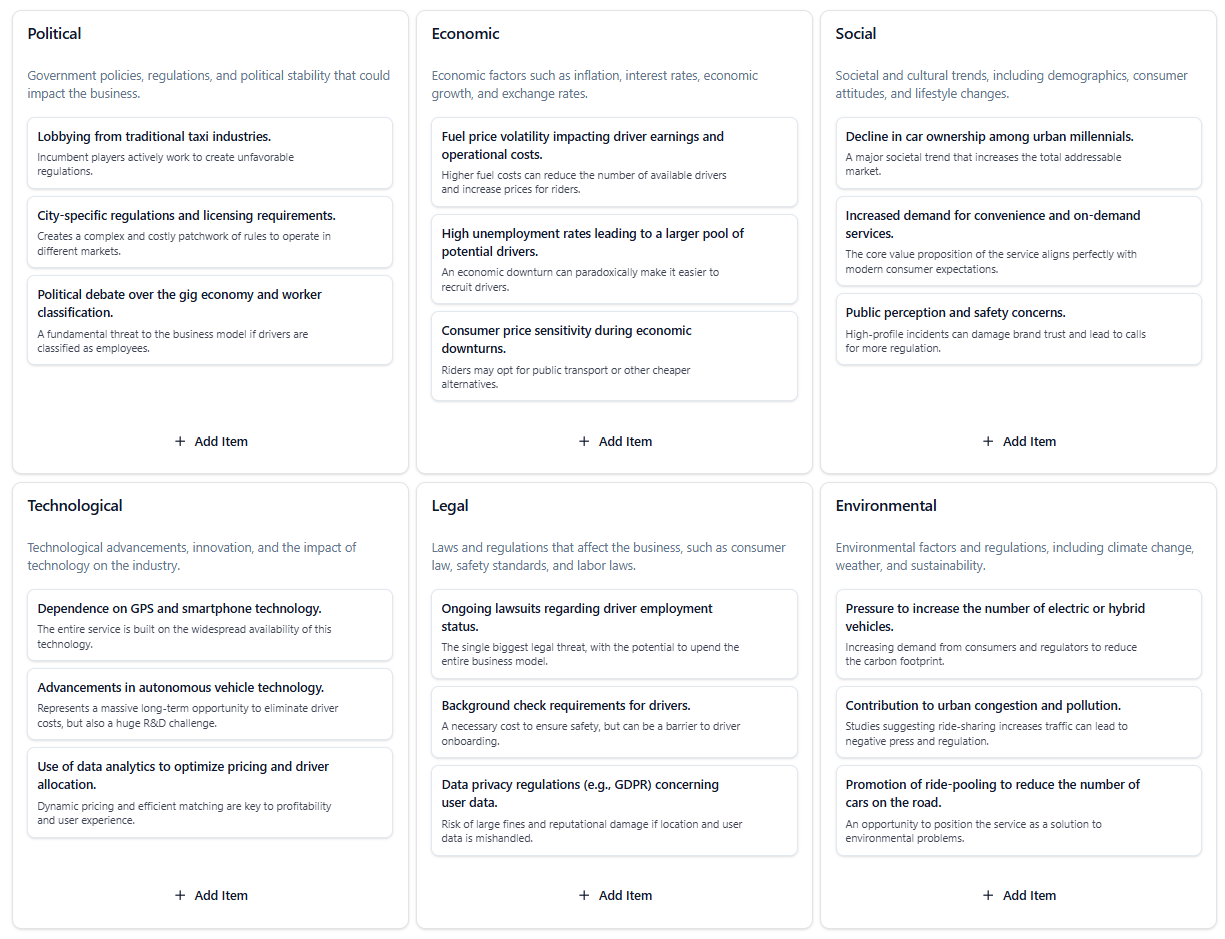
A PESTLE analysis for a global ride-sharing company navigating complex regulations, economic volatility, and technological transformation.
Analysis & Interpretation
Background
This PESTLE analysis examines the external environment influencing a ride-sharing service that operates in multiple markets worldwide. It highlights how politics, law, and technology intersect to create both opportunities and risks in an increasingly competitive mobility sector.
Key Strategic Insights
- Regulatory Complexity as a Barrier and Advantage: Political lobbying from traditional taxi groups and fragmented city-level laws complicate expansion, but established players with strong compliance capabilities can use this as a moat against smaller competitors.
- Economic Sensitivity Shapes Supply and Demand: Fuel price fluctuations and unemployment rates directly affect driver availability and pricing dynamics. Strategic adjustments to incentives and fare algorithms are crucial for balance.
- Cultural Shift Toward Mobility on Demand: Declining car ownership and rising expectations for convenience fuel growth. However, public trust and safety perceptions must be actively managed to sustain reputation.
- Technology as the Core Enabler: Dependence on GPS, smartphones, and data analytics defines operational efficiency. Long-term success hinges on preparing for autonomous vehicles and deepening predictive analytics for better matching and pricing.
- Legal Uncertainty and Labor Challenges: Ongoing lawsuits over driver classification remain existential risks. Proactive legal adaptation and transparent communication will be vital for business continuity.
- Environmental Accountability: Growing pressure to reduce carbon emissions and urban congestion pushes the service toward promoting electric fleets and shared rides, aligning brand purpose with sustainability goals.
Strategic Summary
The company’s competitive edge relies on mastering regulatory navigation, leveraging data for optimization, and aligning innovation with sustainability trends. Balancing flexibility with compliance, while moving toward autonomous and eco-friendly operations, will define long-term resilience in the ride-sharing industry.
How This Canvas Was Constructed
This example demonstrates how AI-assisted frameworks and visual mapping tools integrate to produce a multi-dimensional, data-driven PESTLE Analysis that captures the complexity of global mobility services.

AI Data Modeling
AI analyzed political, legal, and environmental datasets to identify the most impactful external variables influencing operational and regulatory outcomes.

Structured Layer Visualization
Each of the six PESTLE dimensions—Political, Economic, Social, Technological, Legal, and Environmental—was visually layered to reveal cause-effect relationships across categories, such as how legal restrictions interact with economic incentives.

Strategic Insight Refinement
The AI synthesized cross-dimensional patterns, highlighting which forces—like driver classification laws and sustainability mandates—carry the greatest strategic implications for growth and innovation.
Try the Process Yourself
Import this PESTLE Analysis into the platform to explore the full workflow—test new prompts, adjust environmental variables, and refine your strategic understanding interactively.