

Now Reading: AI-Powered Business Model Canvas Software
-
01
AI-Powered Business Model Canvas Software

AI-Powered Business Model Canvas Software
Introduction to the Business Model Canvas
The Business Model Canvas (BMC) has emerged as the global standard for visualizing, designing, and testing business models. Originally proposed by Alexander Osterwalder based on his book Business Model Ontology, this strategic management tool condenses complex business plans into a single, comprehensive page consisting of nine building blocks.
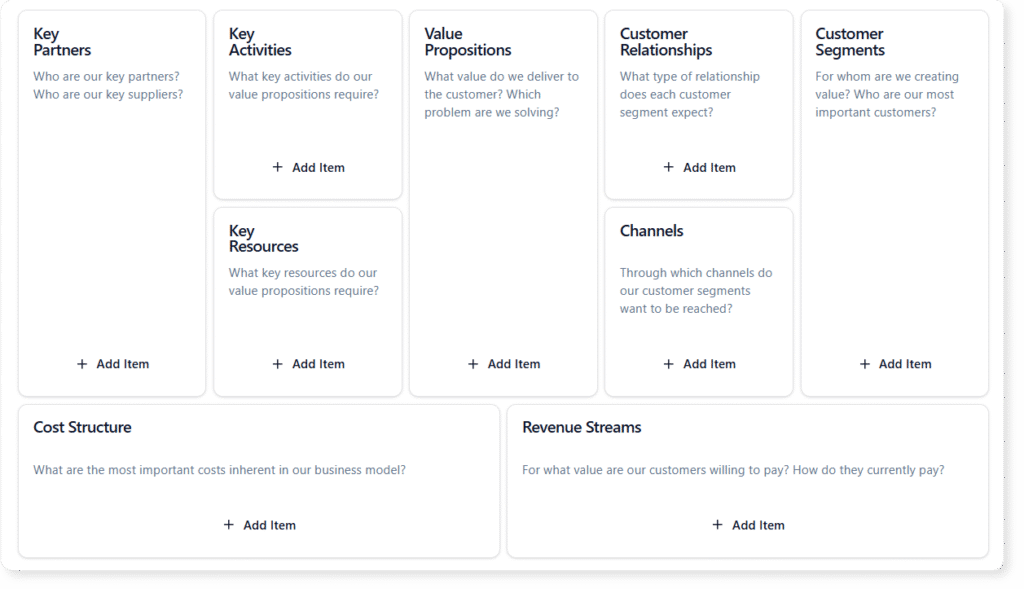
Whether you are a startup founder sketching a noodle food stand idea or an executive at an electronic car company operating like Apple, the BMC allows you to map out the logic of how your organization creates, delivers, and captures value. Unlike traditional 100-page business plans, the canvas is dynamic, iterative, and designed for agility.
The 9 Building Blocks of Business Strategy
The Business Model Canvas systematically breaks down a business into nine essential segments. Understanding these components is crucial for using any digital generator or planning tool effectively.
1. Customer Segments
This block defines the different groups of people or organizations an enterprise aims to reach and serve. Questions to ask include: For whom are we creating value? Who are our most important customers? Segments range from mass markets to niche demographics, such as health-conscious people in New York City or fantasy-friendly markets for on-demand unicorn experiences.
2. Value Propositions
The Value Proposition is the reason why customers turn to one company over another. It solves a customer problem or satisfies a customer need. Whether it is “newness,” “performance,” “customization,” or “cost reduction,” this block describes the bundle of products and services that create value for a specific Customer Segment.
3. Channels
Channels describe how a company communicates with and reaches its Customer Segments to deliver a Value Proposition. This includes awareness, evaluation, purchase, delivery, and after-sales support. Effective channels integrate seamlessly with customer routines, whether through online stores, social media, or physical distribution networks.
4. Customer Relationships
This section outlines the types of relationships a company establishes with specific Customer Segments. Relationships can range from personal assistance to automated services and co-creation communities. Clarifying whether customers expect dedicated support or self-service is vital for cost structure and customer satisfaction.
5. Revenue Streams
Revenue streams represent the cash a company generates from each Customer Segment. This involves asking: For what value are our customers willing to pay? Revenue models can vary widely, including asset sales, usage fees, subscription fees, licensing, or advertising.
6. Key Resources
Every business model requires Key Resources. These assets allow an enterprise to create and offer a Value Proposition, reach markets, maintain relationships, and earn revenues. Resources can be physical (machinery, buildings), intellectual (brand patents, data), human (skilled staff), or financial.
7. Key Activities
These are the most important actions a company must take to operate successfully. For a software company, this might be software development; for a consultancy, it might be problem-solving. Key Activities are required to create and deliver the Value Proposition.
8. Key Partners
Companies forge partnerships to optimize their business models, reduce risk, or acquire resources. This block identifies key suppliers and partners. It answers the question: Which Key Resources are we acquiring from partners, and which Key Activities do partners perform?
9. Cost Structure
This describes all costs incurred to operate a business model. It distinguishes between cost-driven models (leanest cost structure, low price proposition) and value-driven models (focused on value creation, premium proposition). It accounts for fixed costs, variable costs, economies of scale, and economies of scope.
Visual Paradigm AI: Automating and Enhancing Strategy
While the traditional method of using sticky notes on a whiteboard is effective for brainstorming, modern business demands speed and digital integration. Visual Paradigm revolutionizes this process by bringing artificial intelligence into the strategic planning phase.
Smart Generation from Prompts: Visual Paradigm AI allows users to input a brief description of their business idea—such as “Sustainable fashion subscription” or “Learning app for high school children with gamification”—and instantly generates a comprehensive Business Model Canvas. The AI analyzes the prompt and intelligently populates all nine segments with relevant, industry-specific data, saving hours of manual drafting.
Iterative Refinement: The AI does not just provide a static image; it offers a starting point that can be refined. Users can ask the AI to expand on specific sections, such as suggesting additional revenue streams or identifying potential key partners, making the brainstorming process collaborative between the human strategist and the machine.
VP Features: Supporting Strategic Innovation
Visual Paradigm is packed with features designed to support the full lifecycle of business model generation and management.
- Drag-and-Drop Editor: The intuitive interface allows users to easily add, move, and edit notes within the canvas. This friction-free editing is essential for teams that need to pivot quickly and adjust their model as market conditions change.
- Analysis and Reporting: Once the canvas is complete, Visual Paradigm allows for in-depth analysis. You can generate reports, export the canvas in various formats (PDF, PNG, SVG), and present it to stakeholders with professional polish. The tool helps visualize the connections between different building blocks, ensuring a coherent strategy.
- Strategic Analysis Tools: In addition to the BMC, Visual Paradigm provides access to SWOT analysis, PESTLE analysis, and Value Proposition Canvas tools, allowing for a holistic strategic review within a single platform.
By leveraging Visual Paradigm, businesses can move from a simple “brain dump” to a structured, executable strategy. It transforms the theoretical framework of the Business Model Canvas into a practical roadmap for success.